 By Remini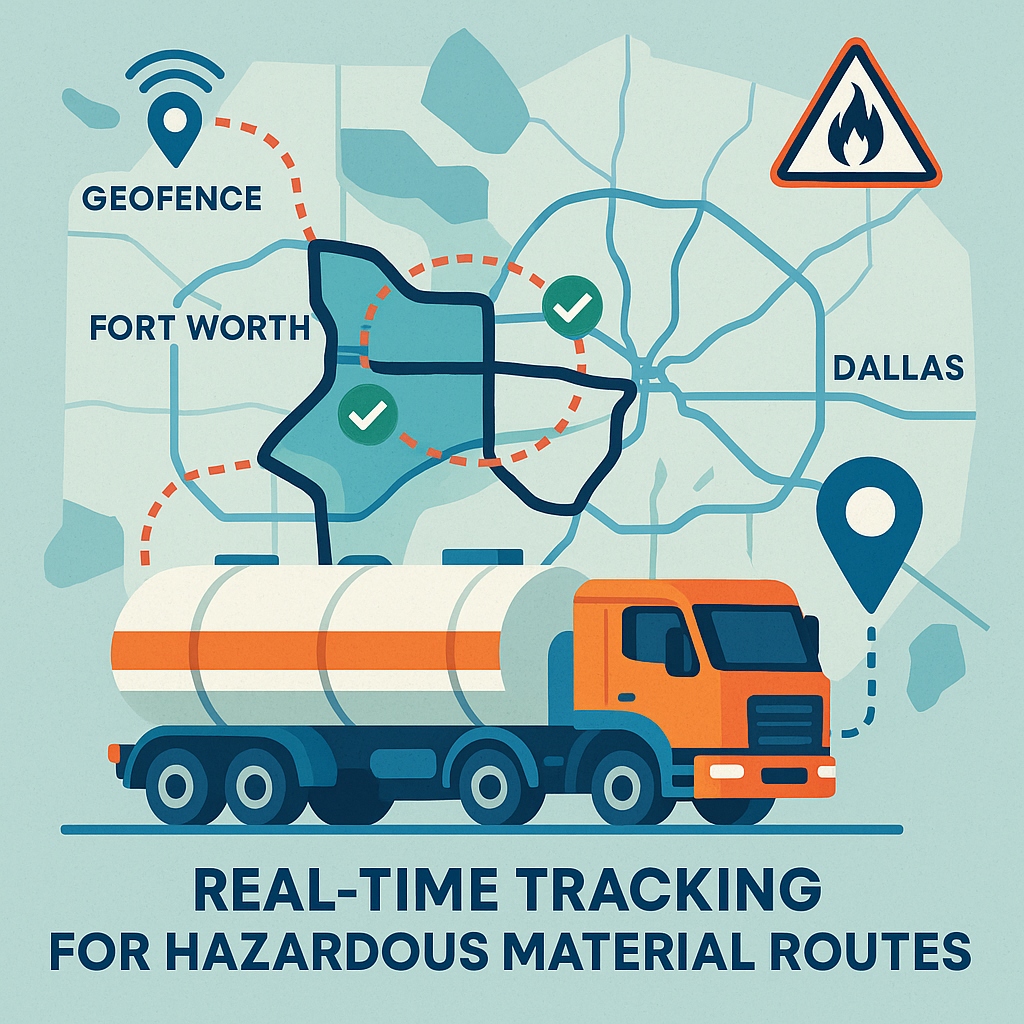
In the ever thrilling environment of hazardous material transportation, nothing is more essential than being aware of your load’s exact position, current state, and whether it is going along the approved path. For operators in the Dallas–Fort Worth corridor, the location of chemical industrial centers, petrochemical plants, and dense urban areas has diversified the tracking solutions for hazmat. DFW hazmat tracking solutions are not only stand-alone systems, they are complementary technologies that provide their own features but also can interact with each other. These solutions enable carriers to mitigate the risk in the corridor, maintain compliance with complex route permits, and ensure the safety of local communities via the applications of geo-fencing hazmat, real-time chemical routes, and integrated telematics.
Dangerous goods transport in the DFW corridor has its unique challenges:
- High Traffic Density: Route alterations on populated areas might not be avoidable sometimes due to congestion caused by millions of vehicles.
- Regulatory Complexity: Agencies like Texas Commission on Environmental Quality (TCEQ), Federal Motor Carrier Safety Administration (FMCSA), and local jurisdictions have rules for chemical shippers, which can be quite different.
- Environmental Sensitivity: Accidental releases or spills are more impactful due to proximity to waterways like the Trinity River.
At the same time that carriers can see traffic on the route, they also get the advantages of using live position feeds with their secured live ETA projections, automated alerts for ELD when routes diverge, etc. Besides that, the out or the in sensor messages keep them informed turkey before the damages happen. This is the value of the transform from the reactive/operational side to the proactive/tourism safety management side.

Any effective tracking program meets the standard of having a GPS telematics unit. These devices update every 30–60 seconds in a manner that the driver apps and the dispatch center feed the data. Current positioning allows:
- Shippers and receivers to have updates on dynamic live ETA
- To optimize the route so no construction and safety-restricted areas are included
- To have historical playback for audit trails and incident logging
ELDs are mandated federally on most tractors. The new ELDs do more than recording the hours of service — they can even send:
- ELD alerts when a driver leaves the pre-approved hazardous route
- Predictions for next duty status changes
- Automatically log the haul’s start and endpoints for the compliance dashboard
The “geo-fencing hazmat” technology enables the carriers to draw polygonal shapes around:
- Safety zones near schools or hospitals
- Industrial areas that are not environmentally friendly
- Bridge and tunnel restrictions
Entering or leaving a geofence automatically sends a driver alert. Along with that, it will inform the back office as well so that they will be ready with the new route that has to be taken. This approach helps to not only eliminate but also prevent any infractions concerning regulations.

In addition to the location, the real safety with hazmat is only achievable through real-time monitoring of the conditions of the cargo. Common sensor thresholds show values like:
| Sensor Type | Parameter Monitored | Warning Threshold | Critical Threshold |
| Temperature Probe | Cargo Temperature (°F) | 75°F | 85°F |
| Pressure Transducer | Container Pressure (psi) | 15 psi | 20 psi |
| Tilt Sensor | Lateral Tilt (degrees) | 5° | 10° |
| Shock Detector | Impact G‑Force | 2 G | 3 G |
Should any value go close to the warning setpoint, the system tells both the driver and the dispatcher to push emergency stops or to correct the speed and the handling, if possible. In the case of telematics + environmental sensors, the layered approach is especially important for chemicals that are heat, vibration, or pressure-sensitive.
Effectively, managing through the maze of local and state route permits can be a very demanding task. However, modern technological platforms make the whole permit management process fluid and easy, which entails:
- Centralizing Documents: Electronic copies of all TCEQ, FMCSA, and municipals.
- Automated Expiry Alerts: The system will notify the manager when any permits are within 30 days of expiry.
- Compliance Dashboards: Each of the dashboard’s permits status, audit logs, and sensor histories are immediately viewable.
A compliance dashboard can illustrate:
- Shipment ID
- Origin & Destination
- Permit Type & Number
- Permit Expiry Date
- Current Route Status (green/yellow/red)
With all the indicators combined in one dashboard, the operation teams can swiftly determine if the truck is cleared by law for the next city or if there is a necessity for a manual intervention.
Despite the fact that everything has been planned with precision, there can occur incidents like mechanical failures, accidents, or adverse weather. An essential workflow for incident logging should have:
- Automated Event Capture: In the case of a shock sensor problem or a distress alert from the driver, the system will geo-tag the event and give the timestamp.
- Immediate Alerts: Notification of the trained Hazmat first responders who are closest to the area along with the safety data sheets (SDS) pertinent to the cargo.
- After-Action Reports: Following every incident, a report will be distributed which contains response time, actions taken, and documents that were filed with any regulatory bodies.
This way detection resolution that is closed-loop helps to demonstrate diligence and enables a carrier to improve safety protocols over time.
A combination of technology and process forms the base of effective risk controls in the DFW corridor.
- Dynamic Rerouting: Modify real-time chemical routes and road high-risk zones at peak times by utilizing traffic feeds.
- Safety Zone Mapping: Automated reroute logic pre-define safety zones in residential areas, near schools, and hospitals.
- Driver Training: Operator training is one of the essential parts to successfully learn about how to react on in-cab alerts popping up and via on how to execute safely emergency stops.
- Stakeholder Communication: Port authorities, city emergency responders, and corporate logistics teams will be provided privileged access to certain layers of information.
By implementing these proactive strategies, carriers can reduce the risk in the corridors and public places and become much safer for the drivers.
A truly 360° solution connects vehicle tracking to the dispatch center:
- Two-Way Messaging: The dispatcher is able to communicate with a driver via a tablet, and send the new route orders without any phone call.
- Automated Tasking: If a threshold breach occurs, the workflow can order a service tech automatically and order the necessary parts.
- Performance Metrics: Dashboards monitor key KPIs to foster ongoing improvement — on-time delivery rates, average response time to alerts, and number of geofence violations.
When tracking data is infused into everyday dispatch workflows, teams can nimbly deliver better outcomes and avert dangerous lapses in safety habits.
HMD Trucking is a regional carrier that focuses on the transportation of bulk chemicals and has recently changed its hazmat operations by using a tracking suite. The important effects were:
- The company used geo-fencing rules tighter than ever to achieve 40% decrease in route deviations.
- Real-time sensor thresholds monitors contributed to a significantly higher speed of 25% in responding to over-temperature events.
- Automated compliance dashboards ensured full alignment of shipment permits with FMCSA and TCEQ requirements.
This transition has become the solid evidence that even the oldest fleets can not only maintain but can also grow and become more sophisticated with the modernization of their hazmat safety stack — thus catering to the needs of the busy DFW corridor and opening more opportunities for Cincinnati trucking jobs.
- Start Small: Launch the system on one route or one type of cargo to work on data flows and alert thresholds.
- Engage Drivers Early: Hands-on training given to the operators is essential to gain their trust in alerts and not dismiss them as “just another notification.”
- Align with Regulators: Share compliance dashboard views with local authorities to build transparency and streamline audits.
- Regularly Review Data: Schedule monthly reviews of incident logs, geofence trips, and sensor excursions to refine settings.
- Invest in Redundancy: Dual‑SIM modems and the backup power feature used for telematics units will help avoid data gaps at critical moments.
Advisors suggest the above approaches should be followed in order to avoid the pitfalls of lingering rollouts thus accelerating tracking investment returns.
In the precondition of the broadening of urban horizons with industrial might in the Dallas–Fort Worth corridor, hazards are unavoidable. But applying DFW hazmat tracking, real-time chemical routes, and geo-fencing hazmat capabilities, the transportation service providers are turning the chaos into certainty. Thanks to the live ETA predictions to proactive ELD alerts, precise sensor thresholds to streamlined route permits, all capabilities point to the flawlessness of the modern tracking ecosystem. By embedding these technologies into dispatch workflows, building driver engagement, and creating synergies with carriers such as HMD Trucking, the sector will be able to move hazardous materials more effectively — thus not only transporting toxic materials but also ensuring peace of mind throughout the whole of North Texas.