 By Remini
In a labor market where skilled candidates have more options than ever, your workplace’s reputation starts to be evaluated long before anyone clicks on the “Apply” button. Candidates look through company reviews, check their presence on social media, and make comparisons of benefits with peers — usually well ahead of time, for example, when a recruiter decides to contact them. This article defines the terms of employer branding and recruitment marketing, presenting them as two interlinked concepts, but at the same time as distinct. We will guide you on the practical playbook you need to build them into a solid data-driven strategy. We shall give background to the areas that matter to job seekers the most: an authentically credible employer brand, a true company culture, a precisely articulated employee value proposition, and finally, a smooth candidate experience from the very first touch to the onboarding process.
Employer branding is the long-term process of establishing your reputation: expressing who you are as an employer and the reasons why people evolve with you. It builds employer reputation, drives talent branding, and enshrines your promise to employees. It is a recruitment marketing strategy that you execute: short-term recruitment campaigns designed to interest people and at the same time recruit them for specific positions.
Employer branding is addressed to your actual employees, alumni, passive talent, and future job seekers. Recruitment marketing, on the other hand, is addressed to had specifically the candidate personas (example, Staff Android Engineer in Berlin, Evening ICU Nurse) with tailored offers, proof points, and candidate sourcing strategies.
The brand is a compound interest — it takes months or years to show results. Campaigns are cyclical — they take weeks or quarters to count.
Brand-level employer messaging is long-lasting: you will have an employee value proposition (what people receive), a mission, values, storytelling about culture, and employee testimonials that humanize work life. Campaign-level branding messaging is specific to the role only: there is the team’s mission, skills needed, growth path, salary bands, location, shift expectations, and manager quotes.
Employed branding is mainly reliant on owned channels (careers site, blogs, social profiles), thought leadership, PR, community and employee advocacy. Activation of the recruitment marketing is done through a combination of both paid and organic acquisition, including job boards, social recruiting, email nurtures, retargeting, and referral drives — plus career site optimization to turn traffic into applications.
Employer branding is assessed using employer branding metrics: brand awareness, sentiment, returning careers-site visits, growth in the talent community, content engagement, and quality-hire over time. Recruitment marketing is a function of the funnel metrics (CTR, apply-start/apply-completion rate, cost-per-apply, cost-per-qualified candidate, time-to-interview, offer rate, offer acceptance, and cost-per-hire).
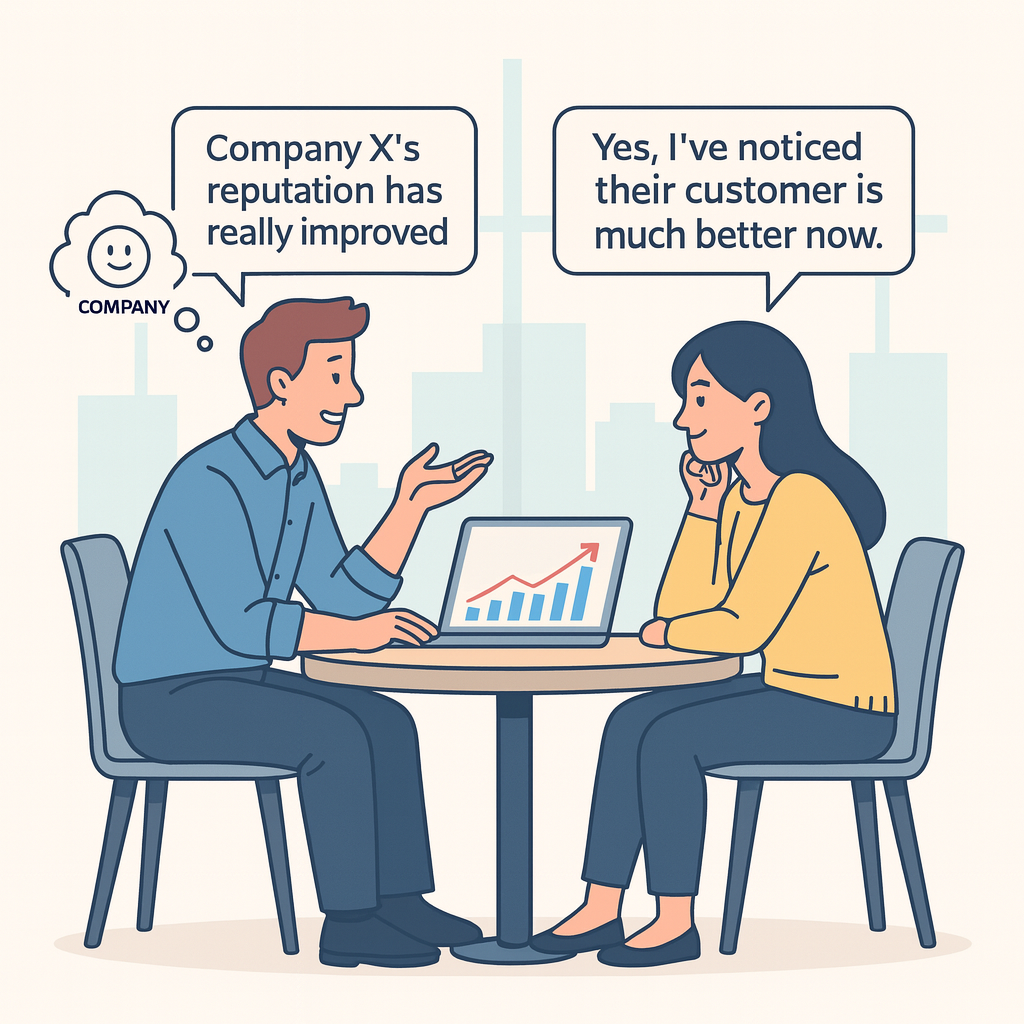
Begin with a lucid company value proposition (EVP) and let each project be designed to integrate it. Alongside keep a single source of truth concerning tone, visuals, benefits, and proof points so that hiring ads consolidate rather than bifurcate your employer branding strategies. Thus, the journey along the candidate path should be consistent and without mixed messages, which would otherwise dampen candidate engagement.
Candidates choose with their hearts and brains. The living story of a brand is the best and most rational way to materialise the culture: day-in-the-life posts, leadership AMAs, ERG spotlights, learning pathways, and internal mobility wins. Use cultural storytelling together with authentic employee testimonials and behind story cultural branding.This integrity will bolster the employer-brand image and it will increase the chances of conversion when people at last find a matching role.
Create an editorial calendar that combines evergreen brand assets with different role-specific explainers: team tech stacks, safety mantra, mentorship footage, shift previews, and “how we work” guides. Launch these across channels such as content marketing, social recruiting, email nurturing, talent communities, and programmatic ads. Also, make sure that the career site is optimized with fast pages, easy-to-use design, structured job content, and pay ranges to minimize drop-outs.

Map out the 3-5 core candidate personas by role family. Capture must-have skills, motivators, blockers, channel preferences, and decision criteria. The role of a persona is to ensure that your recruitment branding is directed to what audience values the most–thus, improving efficiency and bringing down acquisition costs.
Some teams prefer to refer to it as the employee value proposition, others say it as the employer value proposition. Irrespective of the nomenclature it contains, it tells why people join, stay, and thrive, which is the opportunity, impact, belonging, well-being, and rewards. Build it as a true report from your employee input, not just please copy. When the lived experience matches the promise, the referrals and positive reviews you get will compound your employer brand.
The Employee Value Proposition in a Nutshell | AIHR Learning Bite
Go through the competitors career pages, interview experience, benefits, rates of content publish, and voice. Map the area of the agent where your talent branding could find a channel to stand out (eg., documented internal mobility data, leadership accessibility, and remote-first rituals). Over time, by tracking the movement of rankings in the areas mentioned, you will learn whether this is a growing or a lagging employer brand.
Plan content according to the persona and funnel stage. For awareness, tell compelling origin stories and team achievements. For consideration, publish manager Q&As, project deep dives, and “how we collaborate” pieces. For decision, share transparent comp frameworks, interview prep, and relocation support. Repurpose assets across channels — long-form to short video to carousel — to stretch every idea across recruitment campaigns and keep the candidate journey warm.
Have a unified dashboard that includes aspects of both the brand and acquisition: Brand: brand awareness, sentiment, share of voice, return rate on the career site, talent community growth, and employer branding metrics. Acquisition: CTR, apply-start/apply-completion, the source quality mix, interview-to-offer ratio, acceptance rate, time-to-fill, cost-per-hire, first-year retention.
| Stage | Sample Metrics to Monitor |
| Discovery | Impressions, reach, brand search volume, social follows, content reads |
| Interest | CTR, time on careers pages, video completions, newsletter sign-ups |
| Consideration | Apply-start rate, apply-completion rate, assessment pass rate |
| Selection | Qualified interview rate, interview-to-offer rate, candidate satisfaction |
| Hire & Beyond | Offer acceptance rate, 90-day/12-month retention, new-hire eNPS |
Stay alert for changing candidate expectations: flexibility, skills-based hiring, manager enablement, internal mobility, and ethical AI in the workplace. Update the diversity recruiting messaging and benefits language as the norms evolve. New channels arise rapidly, pilot them early and measure them.
Every three months, check if your dashboard meets the targets and compares great with those of peers. Which sources bring you the highest quality individuals? Have you noticed the point where drop-off spikes? Are you improving the interview-to-offer conversion or just top-of-the-funnel volume? Link impacts back to spend and you get the chance to rebalance channels wisely.
Close the back loop with the candidates and new hires. Send two short survey letters (after the interview and 30/90 days post-hire) to track where things go well or what could be improved in the candidate experience and onboarding experience. Within your organization listen to ERGs and manager forums to sharpen policies and messaging.
Think of every role family as a mini growth engine. Put your test-and-learn principles into play for each family: try out different headlines, benefits framing, proof assets (manager quotes vs. employee testimonials), formats (short video vs. carousel), and CTAs. Pilot new candidate sourcing strategies (niche communities, events, alumni groups). Over time, these steady actions will make your employer branding and recruitment marketing systems more intelligent and efficient.
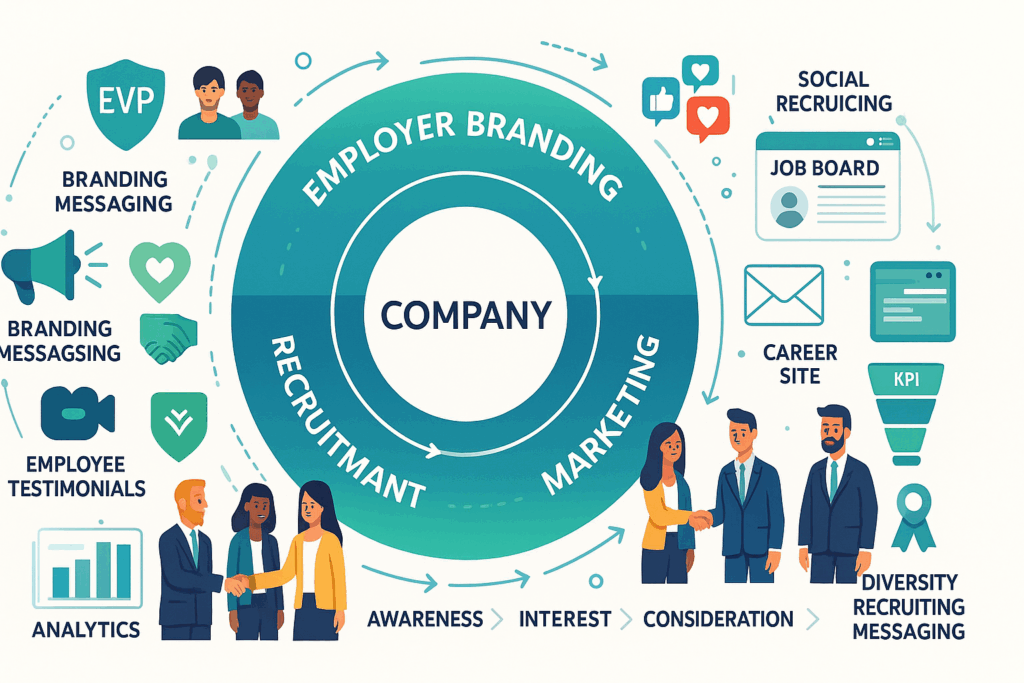
Mastering the talent market requires the use of two muscles that complement each other: the reputation you build and the campaigns you run. Employ employer branding to tell a credible story — through EVP, values, and everyday culture — and use recruitment marketing to distribute that story to the pieces of right candidate personas at the right time. When these discourses support each other, the candidate’s engagement is higher, the recruitment metrics go up and to the right, then the talent acquisition engine compounds. You can make this, your blueprint: align message, publish authentic brand storytelling, operationalise employer branding strategies into repeatable campaigns, and keep on iterating with data and feedback. The diligence with which teams integrate employer branding and recruitment marketing ends up enrolling quicker, at lower costs, and with the best fit people leading to their obvious choice for the talent they most want to get.