 By Remini
In a tight and overly crowded labor market, staffing agencies can only get the attention of clients and candidates by offering them something that is unique. This is a guarantee of survival in the market that is most trusted by time — a great campaign that uses marketing strategies for staffing agencies built on digital marketing, strong employer branding, and data-driven decision-making. As for proper staffing agency marketing, it should cover a wide area of activities ranging from website design, content creation, recruitment marketing, and social media strategies to other tools with two main goals: client acquisition and candidate attraction.
A joint research was conducted by the staffing personnel. Through this report, they found out that the ones who improve inbound marketing, SEO optimization, and recruitment analytics on the web are acknowledged more and are more successful in placement processes than those who do it in the old way like cold calls or job-only boards. In order to scale their digital marketing, agencies should also deal with KPI tracking, marketing automation, and refining their value proposition. The result is a stronger lead generation, a more effective talent acquisition, and a long-term candidate pipeline. Combined with recruitment outsourcing, agencies gain additional benefits such as cost savings, higher scalability, and the ability to expand into specialized areas like healthcare staffing, where demand is rapidly growing.
The website is your agency’s skeleton key that unlocks market entry for both potential clients and prospects browsing through job posts. To maximize effectiveness:
SEO optimization: Equipping the service web pages, headers, and metadata with industry-related keywords will increase the online presence and help in customer acquisition.
Website construction: You have to set up a fast working site that is also mobile-friendly to leverage mobile marketing which is a life saver in this day and age as most apps are used through smartphones.
Value proposition clarity: Display your unique markets, endorsements, and success records to improve the brand awareness of the employer.
Calls-to-action (CTAs): Direct visitors with options like “Register as a candidate,” “Request staffing support,” or “Subscribe to job alerts.”
A properly optimized website increases the capacity of agencies to get the jobs and allows them to make timely responses to staff shortages while also providing essential information on recruitment through analytics. For healthcare staffing, a dedicated landing page supported by healthcare talent analytics can help agencies track candidate behavior and highlight expertise in healthcare hiring.
Social media strategies become the heart of the client acquisition and candidate attraction activity. The omnipresence of LinkedIn, Instagram, Facebook, and X as the main channels for staffing companies employer outreach indicates that engagement should be consistent and authentic mandatory.
Employer branding: Through success stories, company culture function displays, or clinician recruitment support programs illustrate.
Video marketing: Rent a video that contains recruiters, testimonials from candidates or the latest trends in healthcare recruitment.
PPC advertising: Focus on niche markets, passive candidates, or healthcare HR decision-makers by designing personalized campaigns.
Talent engagement: Polls, Q&As, or live sessions are some of the tools to use for engaging and building stronger communities.
Referral programs: Empower clients and candidates to share content, extending reach through sourcing channel diversification.
The combination of social media engagement and KPI tracking supports recruiter process efficiency while expanding both client and healthcare candidate pool reach.
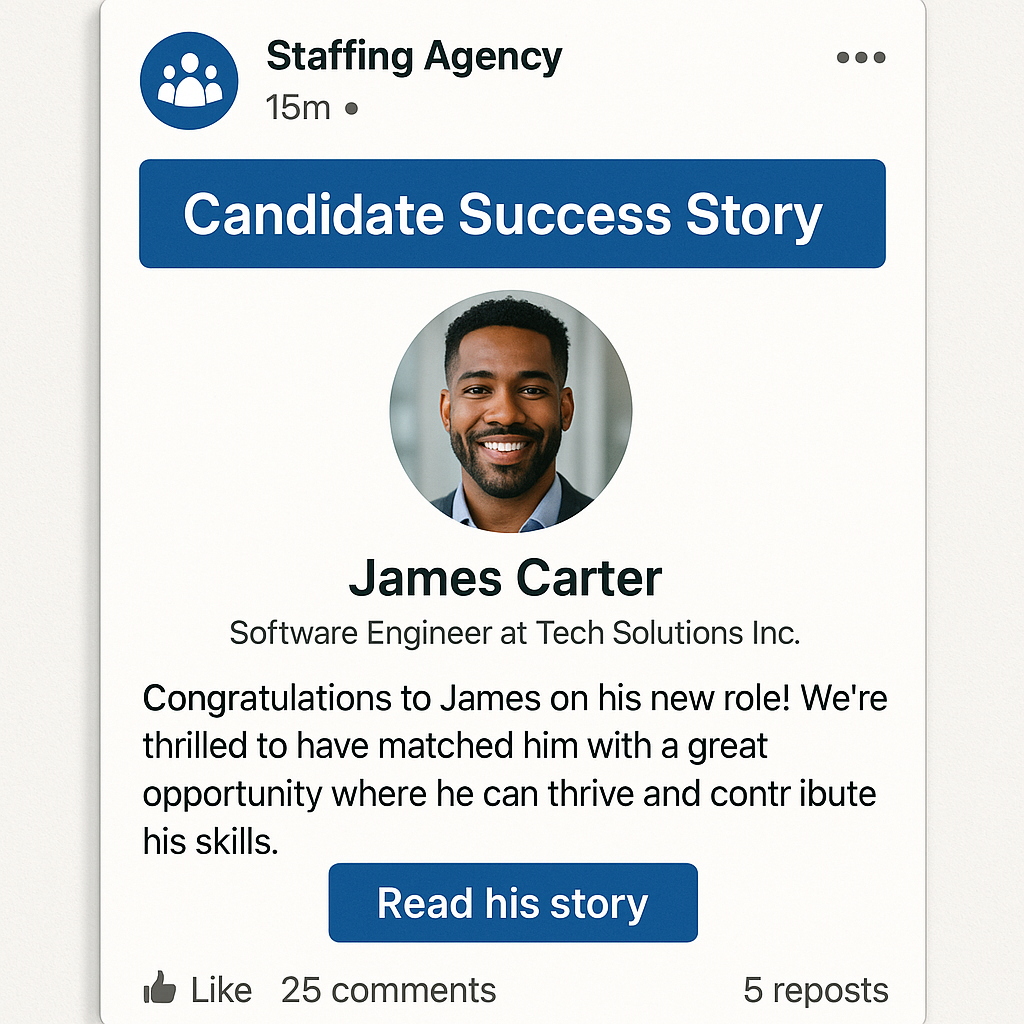
Content is still the backbone of staffing agency marketing, simultaneously boosting long-term visibility and immediate recruitment solutions.
Educational blogs: Cover recruitment outsourcing benefits, talent management practices, or healthcare hiring process challenges.
Downloadables: Salary benchmarks, hiring guides, and whitepapers to capture leads.
Case studies: Demonstrate talent pipeline development or clinical staffing optimization to reinforce value.
Webinars/podcasts: Address topics like RPO benefits, outsourcing advantages, and job market forecasting.
Job board optimization: Improve postings using compliant, industry-specific language aligned with role based hiring and compliance driven hiring.
By integrating recruitment technology and highlighting candidate screening effectiveness, content marketing reinforces trust. For healthcare HR leaders, articles on RPO implementation, RPO providers, and RPO for hospitals can attract attention from decision-makers.

Email campaigns remain one of the most reliable recruitment strategies with strong ROI.
Segmentation: Organize lists by categorizing them into clients, active candidates, alumni, and prospects.
Marketing automation: Use sequences to deliver job alerts, workforce planning updates, or healthcare recruitment strategies.
Mobile-friendly design: Guarantee the clearness of direct CTAs across all devices.
KPI tracking: Monitor open rates, click-throughs, and conversions to improve campaigns.
Personalization: Include niche markets insights, healthcare workforce metrics, or compliance-driven updates.
Email campaigns sustain client retention and foster candidate engagement strategies. Combined with background check automation, talent assessment methods, and hiring process standardization, emails strengthen the overall healthcare candidate experience.
Despite the digitization of recruitment, the referral programs and word-of-mouth plays a crucial part. Clients and candidates, being the potential referrers of these outsourcing products, are sponsored by the company, thus they are “the” invaluable element of the recruitment outsourcing growth.
Referral programs: Clients and candidates get a reward for referring new clients and candidates to the company.
Testimonials: Display the effective healthcare hiring process or the successful physician sourcing stories.
Employer outreach: Team with the local business groups and the industry associations to expand your reach.
Employee advocacy: Encourage staff to share agency updates or insights on interim staffing solutions.
Word-of-mouth validates employer branding, strengthens credibility, and complements recruitment outsourcing strategies by reducing acquisition costs.
A successful staffing agency marketing plan requires precise objectives and reliable metrics:
Define KPIs: Examples include increasing candidate attraction by 30% in six months or expanding outsourced recruitment team capacity for healthcare organizations.
Recruitment analytics: Track where candidates originate — social media, job boards, or referrals — to measure recruitment efficiency.
Niche markets: Prioritize industries like healthcare HR, logistics, or IT, where staffing challenges and healthcare hiring are most urgent.
Workforce planning: Use job market forecasting to anticipate demand, enabling scalable hiring models and cross functional recruitment initiatives.
Clear KPI tracking ensures strategies deliver outsourcing benefits and address client needs efficiently.

Because the recruitment landscape shifts rapidly, continuous monitoring is crucial.
Data analytical tools: Make use of recruitment tech dashboards, Google Analytics and SMTP tracking tools for a fine analysis of the situation.
A/B tests: It is better to make changes in CTAs, subject lines and landing pages that you are targeting for improvements.
Trend monitoring: Watch healthcare recruitment trends, such as remote healthcare recruitment or increasing demand for clinician recruitment support.
Budget reallocation: Promote more successful methods such as PPC advertising or video marketing.
Value updates: Regularly revisit your value proposition to ensure relevance to healthcare recruitment strategy and evolving talent sourcing.
Adjustments support medical staffing outsourcing, sustain healthcare talent pool development, and improve overall scalability.

The future of marketing strategies for staffing agencies is multi-channel, scalable,driven by both technology and human connection. AI powered, portable, handheld imaging devices will surely change the way diagnosis is performed in the hospital. Industry-leading wireless and mobile capabilities are making great processes possible, including the transfer of body images from instrument to instrument or the addition of features such as retrieval, screen sharing, and thread comments on the perturbation of the images.
By applying strategies like website optimization, social media engagement, content creation, email campaigns, referral programs, staffing firms can build strong pipelines, enhance recruitment efficiency and strengthen client retention. With tools like candidate engagement strategies, talent acquisition outsourcing and sourcing channel diversification, they also improve the overall healthcare candidate experience.
The marketing of staffing agencies is not just about placements but it is the way to set the company on the path of long-term fruitful growth. Adding to the strategic staffing solutions by the agency is the staffing of physicians and the talent pipelines development which provides stability of healthcare workforces, while the outsourcing pros of savings in costs, compliance-oriented hiring, and recruiter process productivity mark the difference of sourcing companies from others.
By combining digital marketing, outsourced recruitment team capabilities, and scalable hiring models, agencies can secure their place as trusted partners in talent management, healthcare HR, and beyond.